Somaliland’s Parties Committee Breaks Kulmiye Deadlock.
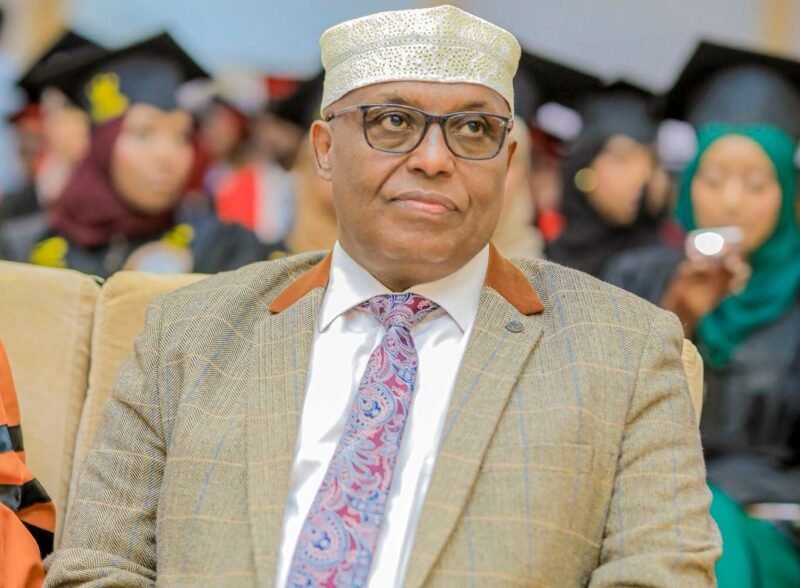
The internal power struggle gripping the Kulmiye party has reached a critical inflection point. The Registration and Approval Committee of Somaliland National Parties and Organizations has stepped in as the ultimate arbiter, delivering a decisive ruling that effectively neutralizes the current party Chairman, Mohamed Kahin Ahmed, and forces the long-delayed party congress.
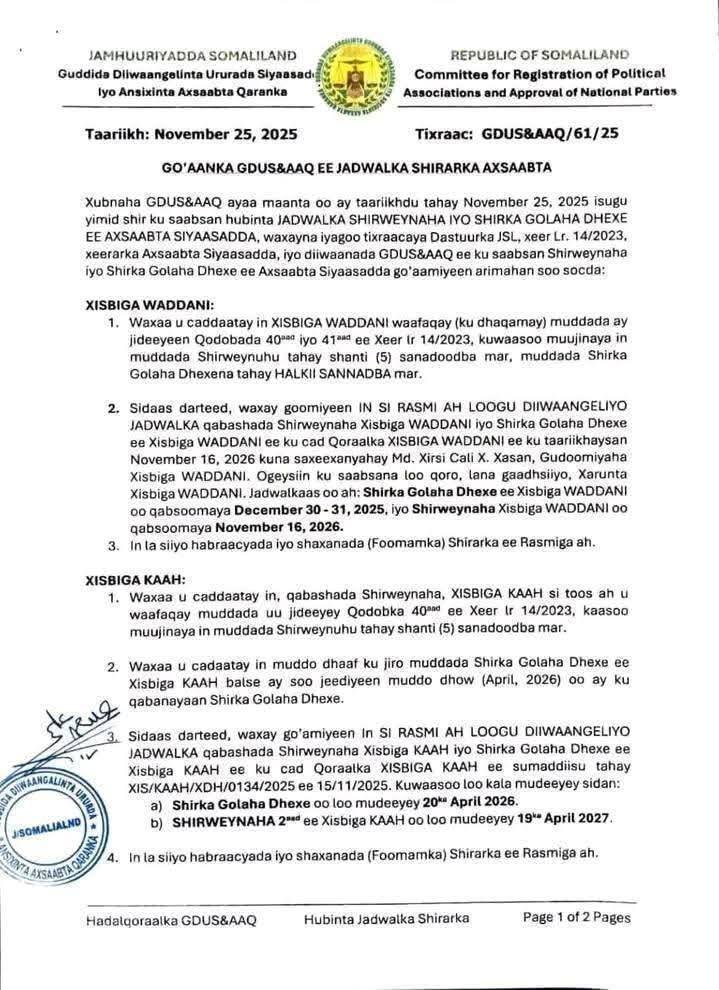
This development fundamentally alters the political calculus, stripping the Kahin faction of its last remaining weapon—the legal authority to delay the internal democratic process.
The CRA’s decision is a masterstroke of institutional enforcement, dissolving the standoff between the administrative leadership and the Central Council majority:
The Registration and Approval Committee of Somaliland National Parties and Organizations unequivocally ruled that Chairman Kahin’s unilateral decision to extend the congress beyond its legal two-year mandate, based on claims of a “national disaster,” was illegal. This reinforces the principle that only the Kulmiye Central Committee, under specific force majeure conditions, has the limited authority to seek an extension, and only for a maximum of one year.
The The Registration and Approval Committee of Somaliland National Parties and Organizations has demanded that Kulmiye set a date for the congress within a short, non-negotiable window of 30 days. This pressure cooker timeline eliminates Kahin’s preferred strategy of indefinite delay.
The most powerful element of the ruling is the threat of institutional seizure. If Kulmiye fails to set a date, the CRA will step in, take control of the organizational process, and unilaterally set the date and time for the congress. This effectively shifts control of the party’s democratic mechanism from the administrative faction (Kahin) to a neutral, legal body (CRA).
The majority faction (the Muse Bihi Abdi base) has secured a profound legal victory. Their strategy of leveraging the Central Council’s majority vote is now virtually guaranteed to succeed because the institutional mechanism to hold the vote has been unlocked and enforced by the CRA.
The actions of Chairman Mohamed Kahin Ahmed remain the most perplexing strategic move in this saga. Why would a long-time ally and political beneficiary of former President Muse Bihi Abdi choose this path of resistance, knowing its legal futility and his lack of internal support?
The context provided reveals a narrative of mass failure and strategic desperation:
Kahin was Bihi’s Interior Minister—the second most powerful official in Somaliland for seven years. His choice to fight the very man who championed his rise, a friendship reportedly spanning five decades, suggests motives far deeper than typical political maneuvering.
The analysis correctly points out Kahin’s association with significant political setbacks, including the loss of Lasanod and the Kulmiye party’s failure to secure a majority in the 2024 elections. Crucially, the reported lack of support from his own eastern Somaliland constituency underscores a severe erosion of his political base. At 82, this fight appears to be a final, high-stakes gamble against the man who made him.
The corridors of Hargeisa political power are now filled with three main theories attempting to explain this extraordinary self-destructive behavior:
The most severe allegation is that Kahin is being strategically utilized by the opposition Waddani party—a claim of sabotage designed to keep Kulmiye paralyzed and unable to unify for the upcoming presidential race.
Political disputes in Somaliland often have deep-seated sub-clan dynamics. This theory suggests Kahin is acting under intense pressure or aligned with a faction focused on securing a different long-term political arrangement, independent of Bihi’s leadership.
Kahin may view himself as the keeper of the party’s legacy or simply refuse to yield control to a perceived successor, fighting a war of pride and political survival against Bihi’s influence.
The CRA’s decision has shifted the power dynamic irrevocably:
The congress will happen within 30 days, either organized by Kulmiye or by the CRA. The Kahin faction’s administrative blockade has failed.
Since the Central Council holds the majority of votes and backs the faction aligned with Muse Bihi, the election of a new party chairman and leadership is virtually guaranteed.
The party will emerge from this congress with a new, unified, and legally ratified leadership—almost certainly one aligned with the Bihi political current. The crucial challenge then becomes one of healing the deep fissures created by this highly personalized and legally contested battle, and pivoting immediately to campaign mode to challenge Waddani and KAAH.
The political system has demonstrated its regulatory capacity. The institutional framework, despite the high-stakes internal power play, has upheld its legal mandate, ensuring that the party’s democratic process, however reluctantly, moves forward.