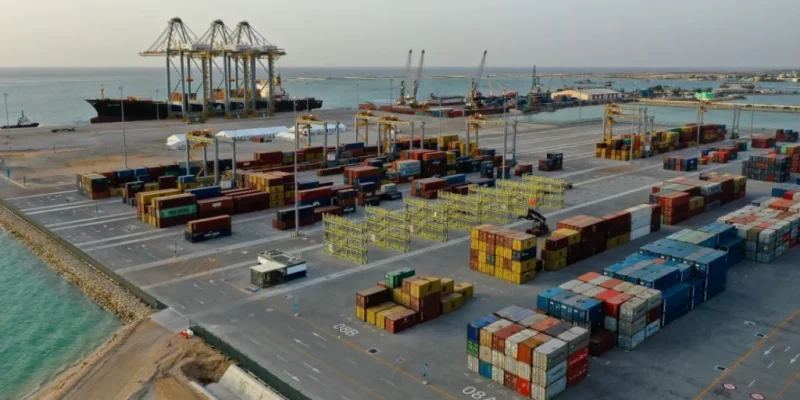
The Government of the Republic of Somaliland firmly rejects the unilateral directive issued by the Federal Government of Somalia (FGS) mandating the use of the Electronic Cargo Tracking Note (ECTN) for all shipments, including those destined for the Port of Berbera.
This decree, cloaked in the language of “modernization” and “anti-smuggling,” is nothing more than a politically motivated attempt to introduce commercial coercion and impose a crippling, redundant tax on the most transparent and secure trade gateway in the Horn of Africa.
The FGS’s Flawed Premise
The FGS narrative claims that the ECTN is necessary because ports in the region operate as “black boxes” ripe for tax evasion and illicit trade. This is a claim of profound irony and demonstrable falsehood when applied to Somaliland.
Our government is proud of the Berbera Port’s proven transparency and efficiency, driven by major international investment and managed by world-class systems. Berbera is not a “black box”; it is a digital, 21st-century operation that already meets and often exceeds global standards:
-
Verified Customs Systems: All customs declarations and revenue collection in Somaliland are fully digitized, tracked, and directly fund our self-reliant national budget. Our financial self-sufficiency stands as the clearest proof of our effective revenue integrity.
-
Advanced Security: Berbera operates under rigorous international security protocols, including advanced scanning and verification processes in cooperation with global partners.
-
Partnership & Trust: The Berbera Corridor serves as the vital trade artery for Ethiopia and the wider region. Our customs data is handled with transparency and professionalism, a foundation of our long-term trade agreements—something the FGS cannot legitimately claim.
It is deeply concerning that an administration (FGS) which recently suffered a catastrophic failure in its federal e-visa system—exposing the sensitive data of thousands and prompting international security warnings—now insists it must be the sole digital custodian for billions of dollars in regional maritime trade data. The ECTN is, at best, a high-risk security proposition and, at worst, a system designed to fail.
A Threat to Regional Economic Stability
The FGS’s insistence on imposing its centralized system on the autonomous and functional ports of Somaliland is purely a projection of unenforceable political power. By threatening “cargo seizures and criminal prosecution,” the FGS is forcing shipping lines into a scenario of double taxation. This is a direct act of economic sabotage aimed at penalizing international commerce and destabilizing the Berbera Corridor.
This move does not foster state-building; it creates regional friction, undermines the legitimate trade routes critical for landlocked nations, and attempts to slow the economic momentum of a democratic and stable nation.
Somaliland’s Commitment to Trade
Somaliland’s commitment is clear: we are dedicated to free, fair, and secure trade. We will not allow the FGS to leverage international tools for domestic political interference.
We call upon our international partners, including the European Union, the United States, and especially the Federal Democratic Republic of Ethiopia, to recognize the ECTN mandate for what it is: a non-technical, politically motivated decree. We urge all shipping agents, carriers, and international firms to continue using the proven, secure, and transparent systems already in place at the Port of Berbera.
Somaliland remains the reliable, democratic, and transparent gateway to the Horn of Africa, fully capable and committed to managing its ports and economy in line with the highest global standards.
— Ministry of Commerce, Industry, and Tourism, Hargeisa, Republic of Somaliland